The market around coding automation has moved far beyond a niche back-office software category. The computer-assisted coding software market is projected to grow from USD 6.5 billion in 2025 to USD 15.8 billion by 2035 at a 10.3% CAGR, according to Future Market Insights on the CAC software market. For a hospital CFO, that projection matters for one reason: organizations aren’t buying these platforms for convenience. They’re buying them because coding accuracy now sits directly on the path to cash flow, denial prevention, and audit defense.
Medical coding auditing tools used to be framed as quality-control software. That’s too small a view. In practice, the right platform changes how a health system protects reimbursement, scales oversight, and proves that billed services are supported by documentation. The wrong platform adds another dashboard, another queue, and another integration headache.
The High Stakes of Coding Accuracy in 2026
Coding accuracy has become a board-level revenue integrity issue. Payer scrutiny is heavier, code sets remain complex, and documentation expectations keep tightening. At the same time, most hospitals still need to move volume through the revenue cycle without adding friction for coding teams, CDI staff, and patient financial services.
That pressure is why medical coding auditing tools matter. They sit in the middle of three problems that CFOs care about:
- Revenue leakage: unsupported codes, missed specificity, modifier errors, and preventable denials
- Operational drag: too much manual review, too many low-value touchpoints, too much rework
- Compliance exposure: weak audit trails, inconsistent audit methodology, and limited visibility into recurring risk patterns
A strong auditing platform doesn’t just find errors after the claim is out the door. It helps teams prevent avoidable mistakes before billing, route high-risk cases to the right reviewers, and document the rationale behind corrections.
A coding audit program becomes financially meaningful when it shifts from retrospective policing to prospective revenue protection.
For finance leaders, the better question isn’t whether to modernize auditing. It’s where the platform should create measurable impact first. In most systems, that means cleaner claims at the front end, fewer downstream denials, more stable coder performance, and stronger support when payers challenge medical necessity or coding logic.
There’s also a scale issue. Large systems can’t rely on heroics from a small audit team. They need workflows that hold up across multiple facilities, specialties, and payer rules. That’s where tool design starts to matter more than feature count.
Beyond Manual Spot Checks The New Auditing Paradigm
Manual auditing still exists in most organizations, but relying on it as the primary control is like assigning a security guard to check a few random doors each night and assuming the whole building is safe. You may catch something. You won’t see the full risk pattern.

The older model depends on retrospective reviews and random chart pulls. That approach has value, but it misses the bigger opportunity. Among organizations that perform formal documentation and coding audits, 75% still rely on random sampling, while only 25% use advanced data analytics to target high-risk areas, as reported by RACmonitor on accelerating payor audits.
What changes with modern tools
Modern medical coding auditing tools let teams move from isolated chart reviews to a continuous monitoring model. The shift changes the auditor’s role in several ways:
- From sample review to risk detection: the software surfaces patterns across coders, providers, departments, and denial types
- From retrospective correction to prospective prevention: high-risk mismatches can be flagged before claims are submitted
- From individual error tracking to process redesign: audit findings become operational intelligence for education and workflow improvement
That last point matters more than many organizations realize. Good audit teams don’t create value by counting mistakes. They create value by reducing repeat mistakes.
Why random review alone stops scaling
Random sampling has one big weakness. It treats all claims as equally likely to fail. They’re not.
A risk-based model directs attention where exposure is highest, such as specialty-specific coding drift, recurring modifier problems, documentation gaps tied to medical necessity, or patterns connected to one payer. Technology handles the sorting. Human auditors handle the judgment.
Practical rule: Let the platform find the haystacks. Let auditors inspect the needles.
When this works well, auditors spend less time pulling charts and more time answering questions that improve financial performance. Why are outpatient edits recurring in one service line? Why are denials clustering around certain code combinations? Which provider groups need documentation education instead of repeated rework?
That is a major transformation. The audit function stops being a back-end checkpoint and becomes a control tower for revenue integrity.
Anatomy of a Modern Medical Coding Auditing Tool
A modern platform is more than a digital scorecard. It’s a connected system that ingests records, applies coding logic, prioritizes risk, routes work, and documents decisions in a way finance and compliance leaders can defend.
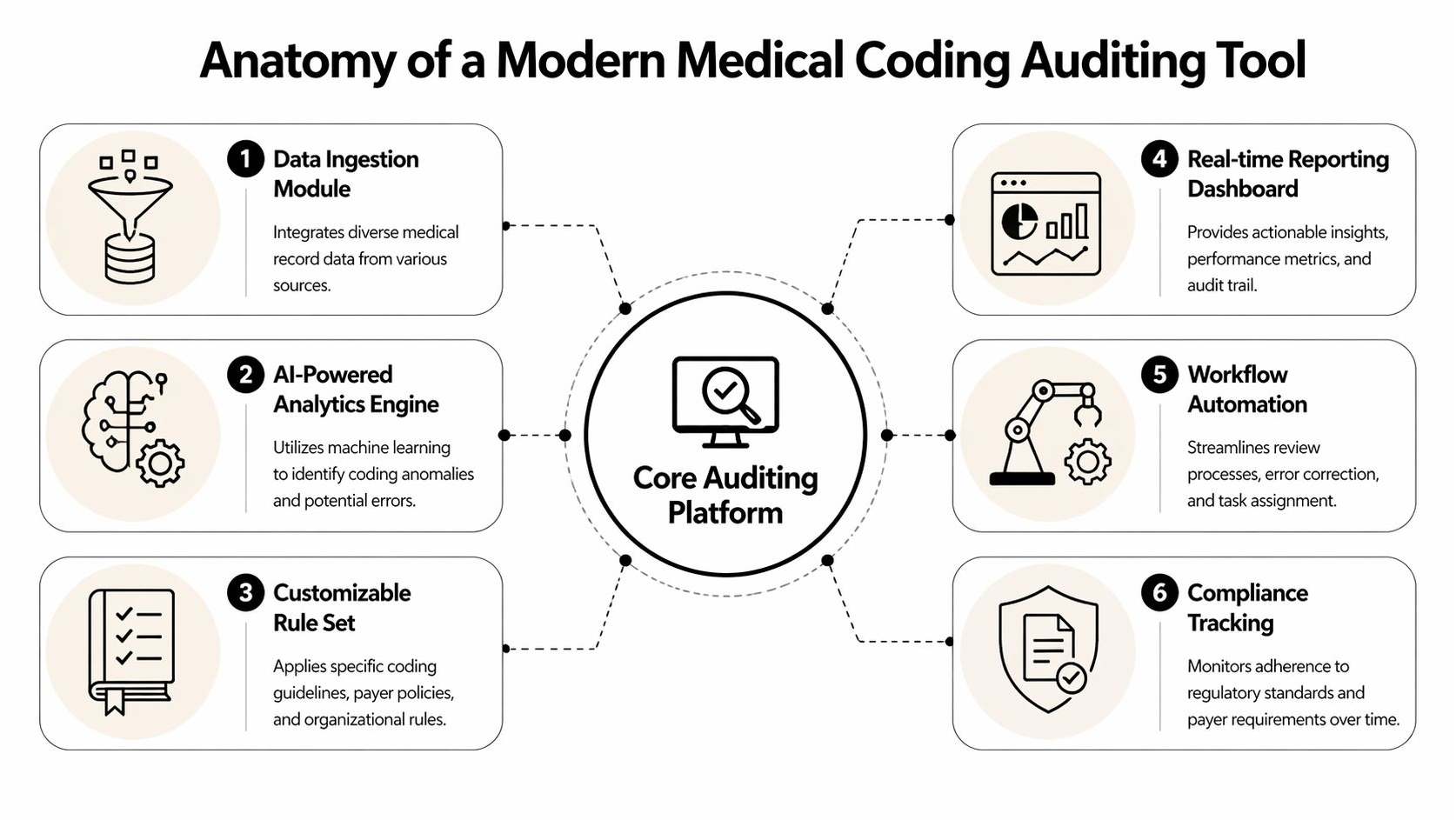
Rules engine and encoder integration
The first thing to look for is automated validation against coding and payer logic. The platform should check claims against NCCI edits, LCD/NCD rules, and ICD-10-CM/PCS, CPT, and HCPCS guidelines before billing where possible.
That capability is not cosmetic. Integrated, encoder-based auditing tools can reduce manual review time.
A finance leader doesn’t need to memorize every edit set. The operational takeaway is simple. Better front-end validation means fewer claims sent out with known defects.
AI and NLP review of documentation
The next layer is AI and NLP. Used correctly, these tools review unstructured physician documentation and compare it against coded output. That helps identify missing specificity, unsupported E/M levels, or diagnosis-to-procedure mismatches that a purely manual process may miss until denial or audit.
Many buyers get distracted by buzzwords. The useful question isn’t whether a vendor says “AI.” It’s whether the output is tied to evidence in the chart and whether an auditor can see why the system flagged the issue.
A practical example of feature-to-outcome mapping appears in this explanation of how coding audit software catches errors. The value comes from traceability, not novelty.
Intelligent work queues and sampling
High-functioning tools also prioritize what gets reviewed. They don’t dump every claim into the same queue. They sort by risk, service line, payer behavior, coder variance, and recurring denial categories.
That matters operationally because teams rarely have unlimited audit capacity. Intelligent sampling puts scarce reviewer time where it changes outcomes.
Workflow, education, and dashboards
The final components are often overlooked and are usually where implementations succeed or fail:
- Workflow automation: assignment, escalation, and closure management
- Coder scorecards: trend lines by coder, provider, department, or claim type
- Education loops: feedback tied to actual audit findings
- Reporting dashboards: reason-for-change categories, denial correlations, and audit trail visibility
If your platform can flag an error but can’t route it, teach from it, and report on recurrence, you bought a detector instead of an operating system.
For CFOs, this is the anatomy that matters. Every component should either remove labor, prevent denials, support reimbursement accuracy, or strengthen audit defensibility. If it doesn’t do one of those jobs, it’s probably noise.
Translating Features into Financial and Operational Wins
A hospital doesn’t invest in medical coding auditing tools because the interface looks modern. It invests because the tool changes measurable financial outcomes.

The most important shift for the C-suite is to stop treating audit software as a compliance purchase alone. It’s a working capital tool, a margin protection tool, and a scalability tool.
Denial prevention and cleaner claims
The denial story is getting worse, not easier. Hospital outpatient coding-related denials rose 26% in 2025 after a 126% surge in 2024, based on the verified data provided earlier. That’s why prospective controls matter more than retrospective findings.
When a platform validates code combinations, diagnosis support, and documentation sufficiency before billing, it reduces avoidable downstream work. Fewer bad claims means less rebilling, fewer appeals, and less staff time tied up in correction loops.
A useful operating principle is this:
- Front-end accuracy improves clean claim rate
- Clean claims improve cash acceleration
- Faster cash reduces AR pressure
- Lower rework reduces labor cost
That’s the financial chain CFOs should evaluate.
Audit defensibility and revenue protection
Stronger tooling also improves the organization’s posture when payers challenge claims. A weak manual process often leaves gaps in who reviewed what, why a code changed, and what evidence supported the final billed position.
A stronger platform creates a documented sequence. It shows the initial coding decision, the validation result, the reviewer’s rationale, and the correction path. That matters when the organization has to defend claims under increasing audit pressure.
For leaders focused on labor efficiency, examples such as using medical coding audit software to cut work and overtime are useful because they connect process redesign to staffing reality.
Here’s a short explainer that many executive teams find helpful before they finalize business cases:
Accuracy, RAF support, and operational scale
In risk adjustment environments, better audit tools also help identify documentation support issues before unsupported diagnoses create downstream compliance trouble. In fee-for-service environments, they tighten coding consistency across specialties and facilities.
Operationally, the gain is consistency. A platform standardizes how reviewers apply rules, how findings are categorized, and how education gets delivered. That’s what lets a system expand without seeing accuracy fall apart from one facility to the next.
The strongest ROI usually comes from preventing recurring defects, not from finding isolated ones.
One option in the market that fits into the discussion is GeBBS Healthcare Solutions. Its technology-enabled RCM and coding audit capabilities are designed to connect audit workflows, analytics, and automation with broader revenue cycle operations. That kind of integration matters when the goal is not just to review charts but to change financial performance.
How to Select and Implement Your Auditing Platform
Most failed software purchases don’t fail because the vendor lacked features. They fail because the buying team didn’t define what the platform had to do inside the existing revenue cycle.
The first screen should be business fit. Can the tool support inpatient, outpatient, profee, and specialty workflows? Can it align with existing EHR and encoder environments? Can it support both prospective and retrospective auditing without forcing teams into parallel manual processes?
Start with selection criteria that finance can defend
A practical buying framework should look like this:
| Criteria | What to Look For | Why It Matters |
|---|---|---|
| Integration capability | Proven connection to your EHR, encoder, and RCM environment | Weak integration slows adoption and creates duplicate work |
| Audit methodology support | Configurable workflows for prospective and retrospective audits | Different claim types need different review models |
| Reporting depth | Dashboards that show findings, recurrence, and reason-for-change trends | Leadership needs operational and financial visibility |
| Workflow control | Assignment, escalation, feedback loops, and closure tracking | Audit findings need action, not just observation |
| Explainability | Clear rationale behind flags and recommendations | Compliance teams must defend the logic behind corrections |
| Scalability | Support for multiple facilities, specialties, and user roles | A point solution won’t hold up in a health system rollout |
| Vendor support | Strong implementation team, training plan, and governance cadence | The software only works if users adopt it consistently |
Don’t underestimate integration risk
Integration is where many projects stall. A 2025 analysis found that 62% of health systems reported delays of more than six months when integrating new technology with existing EHRs, according to GeBBS on revenue impact from medical coding auditing tools.
That number should change how you buy. Don’t just ask whether the vendor “integrates.” Ask for proof of how data moves, how exceptions are handled, and how updates are managed when your EHR workflow changes.
Buy the implementation model as carefully as you buy the software.
Roll out in phases, not all at once
A phased rollout works better than a systemwide launch. Start where coding complexity and financial exposure are both high. Then expand once the workflow, education model, and reporting cadence are stable.
A disciplined rollout usually includes:
- A focused pilot: choose one high-risk service line or claim category.
- Clear baseline metrics: define current coder accuracy trends, clean claim performance, and denial categories.
- Coder and auditor training: show users how flags are generated and how findings should be documented.
- Governance meetings: review exceptions, adoption blockers, and feedback from operations.
- Broader expansion: add departments only after the first workflow is functioning consistently.
If you’re assessing platforms with dedicated audit workflow support, reviewing options such as iCode Assurance can help clarify what mature audit management functionality looks like.
Tracking ROI and Ensuring Long-Term Compliance
The post-go-live question is simple. Is the platform changing results, or is it just producing more reports?
That answer requires a short list of metrics tied to finance, operations, and compliance. Too many teams track activity instead of impact. Number of audits completed is useful. It is not ROI.

Metrics that matter after go-live
Track the measures that show whether coding quality is improving and whether the improvement affects cash and rework:
- Clean claim rate: one of the clearest front-end signals that edits and audit logic are working
- Coder accuracy trend: not just a point-in-time score, but recurrence by error type
- Reason-for-change patterns: documentation gaps, code selection errors, modifier issues, and payer rule conflicts
- Denial mix shift: whether coding-related denials are dropping relative to total denials
- AR days movement: whether cleaner billing is shortening the path from submission to cash
- Education effectiveness: whether repeat findings decline after feedback and retraining
A useful dashboard should let leaders segment these metrics by facility, service line, payer, and coder. If reporting stays too aggregated, patterns get buried.
What defensible AI looks like
For practical purposes, defensible AI in medical coding auditing tools should include:
- Evidence-linked flags: the user can see what documentation triggered the recommendation
- Human review checkpoints: auditors approve, reject, or amend suggested changes
- Immutable audit logs: every action is time-stamped and attributable
- Version visibility: teams can identify which rule set or logic path was applied
- Exception workflows: unresolved or disputed findings are escalated, not buried
If an auditor can’t explain a code recommendation to compliance counsel or a payer reviewer, the platform isn’t ready for enterprise use.
That’s the standard. ROI and compliance are not separate tracks. In revenue cycle, the most valuable automation is the automation you can defend.
Your Next Move in Revenue Cycle Modernization
Medical coding auditing tools have moved into the core operating stack of modern revenue cycle management. They’re no longer just QA utilities for the HIM department. They influence denial prevention, clean claim performance, staff productivity, and audit readiness.
For hospital leadership, the smartest move is to evaluate these platforms the way you’d evaluate any capital or operating investment. Look at financial impact first. Then test whether the workflow, governance, and audit trail are strong enough to support systemwide adoption.
The organizations that get value from these tools usually do three things well. They target high-risk workflows first. They insist on integration and explainability. They measure success in cash, rework, and compliance exposure, not in software usage alone.
That’s what turns auditing from a cost center activity into a control point for margin protection.
Frequently Asked Questions
Do medical coding auditing tools replace human auditors
No. They reduce manual detection work and improve prioritization, but auditors still need to interpret documentation, validate findings, and manage education.
What should a CFO ask a vendor first
Ask how the tool reduces denials, supports cleaner claims, shortens rework cycles, and documents every audit decision. Then ask how long integration typically takes in your EHR environment.
Should we start with retrospective or prospective audits
If your goal is faster financial impact, prospective auditing usually creates value sooner because it prevents bad claims before submission. Retrospective review remains important for trend analysis, compliance review, and education.
What makes a platform risky to buy
Poor integration, weak audit trail design, black-box AI logic, and reporting that can’t tie findings to operational action are the most common warning signs.
If your organization is evaluating how to modernize coding audits without disrupting the broader revenue cycle, GeBBS Healthcare Solutions is one option to review. The company provides technology-enabled RCM, coding audit support, analytics, and automation that align audit workflows with denial prevention, reimbursement accuracy, and enterprise-scale operations.